Insights
The real cost of an unanswered RFQ
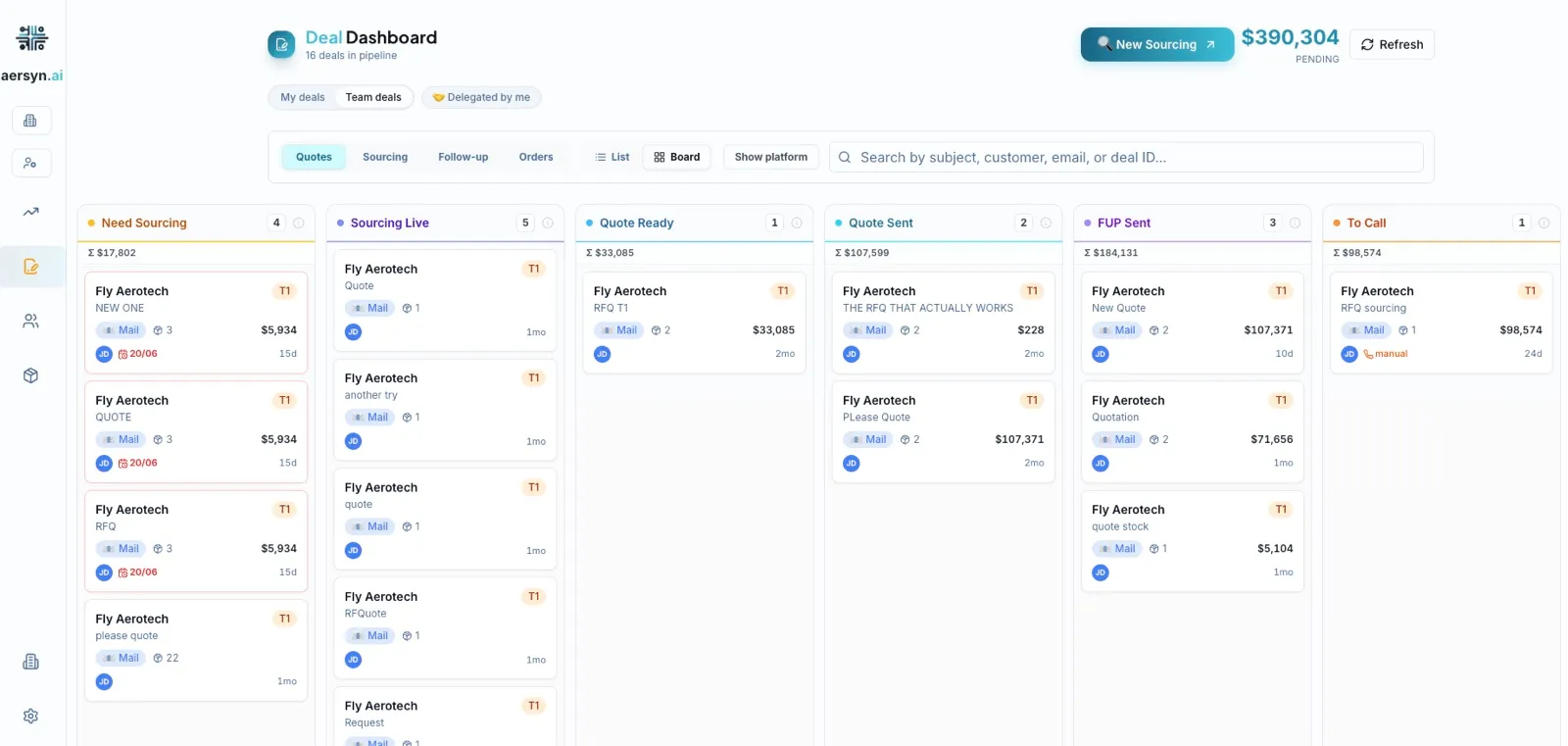
Every parts trading desk I know leaves RFQs unanswered. Not the good ones, in theory. In practice, when a trader is buried, the triage is brutal: quote what looks winnable right now, skip the rest, move on. Nobody logs the skipped ones. Nobody counts them. And that is exactly why the cost stays invisible.
Why does the cost never show up in the P&L?
Because accounting only records what happened, and an unanswered RFQ is something that did not happen. A lost deal you quoted at least leaves a trace: a quote in the system, a no from the customer, a data point. An RFQ you never answered leaves nothing. No line, no report, no uncomfortable number in the Monday meeting.
Your P&L will tell you your margin eroded or your revenue plateaued. It will never tell you that a fifth of your inbound demand went straight to a competitor because nobody replied.
What is the arithmetic of an unanswered RFQ?
Unanswered RFQs per month, times your win rate, times your average order value, times your margin. That is the whole formula. Put your own numbers in.
Take a mid-size desk as a worked example. Say 600 RFQs a month come in and 150 never get a reply. With a win rate somewhere in the 10-20% range, call it 12%, those 150 RFQs represent roughly 18 orders a month you never competed for. At an average order of 9,000 dollars, that is around 160,000 dollars of monthly revenue outside the race. At a 20% gross margin, you are quietly walking past about 30,000 dollars of margin every month. Close to 400,000 a year.
These are placeholder numbers, not a measurement. Your desk’s numbers are sitting in your inbox right now, and they are probably not smaller.
What does an unanswered RFQ cost besides the deal?
Market intelligence, and that part compounds. Every RFQ tells you who is buying what, at what volume, how often. A part number requested thirty times in a month that you do not stock is a buy signal. A customer whose requests suddenly doubled is an account signal. When RFQs die unread in Outlook, none of that ever reaches your ERP or your purchasing decisions.
So the desk loses twice. Once on the deal, once on the data. The second loss is worse, because it degrades every future pricing and stocking decision, and nobody can point to the day it happened.
Where do you start if you want the real number?
Count them for one week. Not a project, not a dashboard, just a count: how many RFQs arrived, how many got a reply, how long the replies took. Every desk can do this from the inbox in an afternoon.
Then run the arithmetic above with your own win rate and order values. If the yearly number does not bother you, close this tab, your desk is fine. If it does, the fix is capacity, not discipline. Your traders are not skipping RFQs because they are careless. They are skipping them because rebuilding a quote by hand takes minutes they do not have. That is the problem aersyn.ai was built around: the drafts get prepared, the trader decides, and the skipped pile stops existing. The pricing is public on the pricing page if you want to compare it against your number.