
Insights
Why we put less AI in, not more
Right now the fashion is AI agents that handle everything by themselves: read the emails, negotiate, update the stock. On LinkedIn it is sold as the miracle. On a real trading desk, it is a liability. So when I built aersyn.ai, I made the least fashionable choice possible: I put in the least AI I could get away with.
Why would a software founder use less AI?
Because an AI does not understand your business, it calculates probabilities. A large language model predicts the most plausible next word. That is a phenomenal tool for reading a messy RFQ or drafting a clean reply. It is a terrible basis for deciding your margin, editing your ERP, or committing your company to a price. Probability engines hallucinate, and on a parts desk a hallucination is not a bug ticket. It is a wrong price sent to a real customer, and reputation you do not get back.
What did we refuse to build?
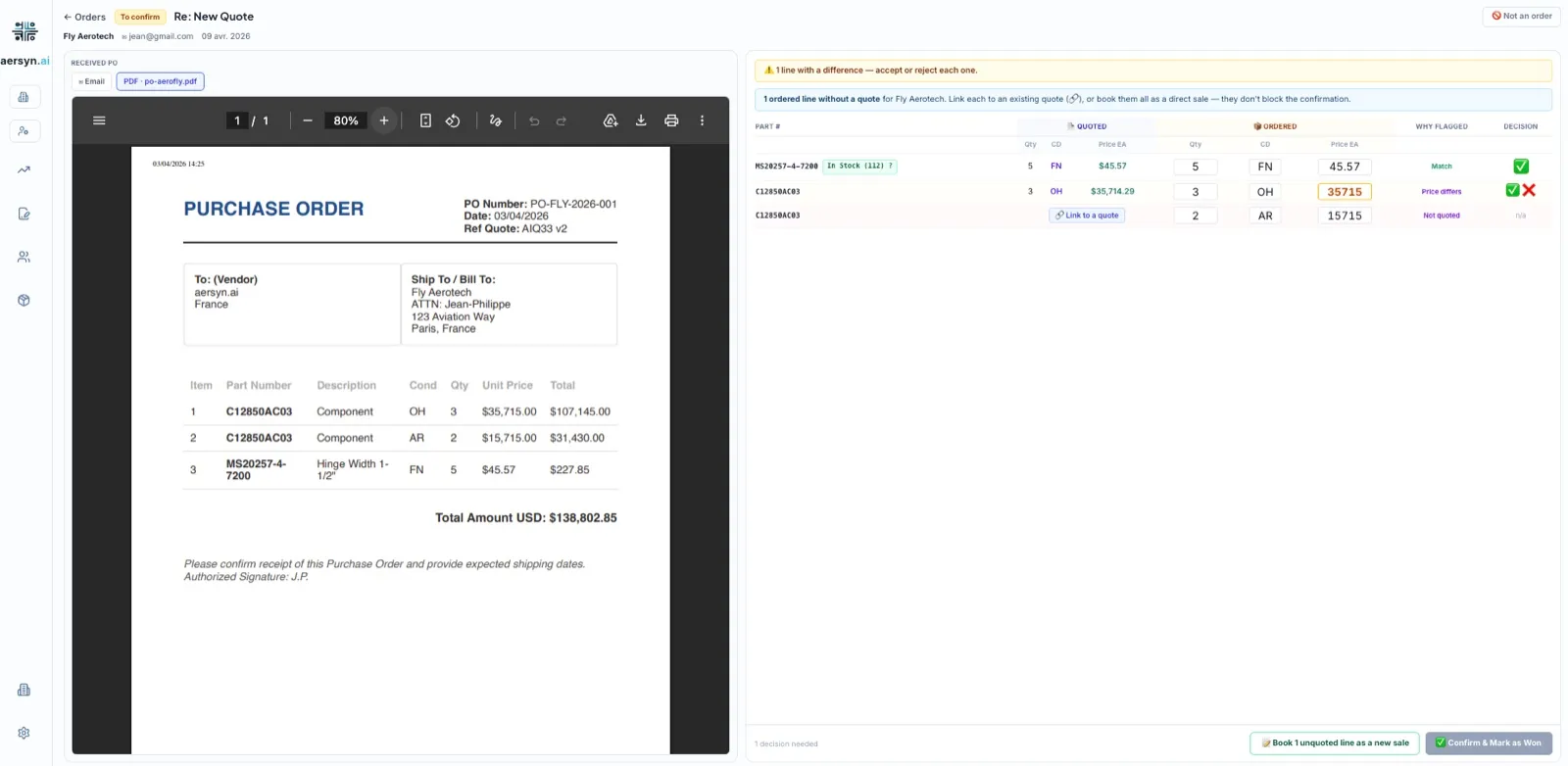
An AI that acts on its own. No agent that negotiates in your name. No agent that writes to your ERP without a check. No agent that sends anything the desk has not decided to send. In aersyn.ai the AI drafts, formats, extracts and suggests, and deterministic code, plain hard logic that I control line by line, validates every step, locks the data, and gates every action. The AI never sends on its own. The AI is an excellent engine. It should never hold the wheel.
What does Thales have to do with it?
Everything, because that is where I learned how you treat systems that are not allowed to fail. You do not test an autopilot in flight with passengers on board. You test it on the ground, on a bench, with real data, again and again. I apply the same rule to aersyn.ai. Everything is logged, so I can replay any past scenario like an incident investigation. Nothing ships without validation on real data first. And the system double-checks itself so hard that during tests it has flagged inconsistencies inside customers’ own ERP data. That discipline is the product. The details are on the security page.
Doesn’t a desk want maximum automation?
No. A desk wants maximum output with zero surprises, and those are not the same thing. Traders do not want a black box deciding margin on a part they have sold for ten years. They want the typing to disappear and the judgment to stay in their hands. Move-fast-and-break-things is fine when breaking things means a broken web page. In aeronautics trading, what breaks is a margin, a relationship, a reputation.
So what is the actual advantage?
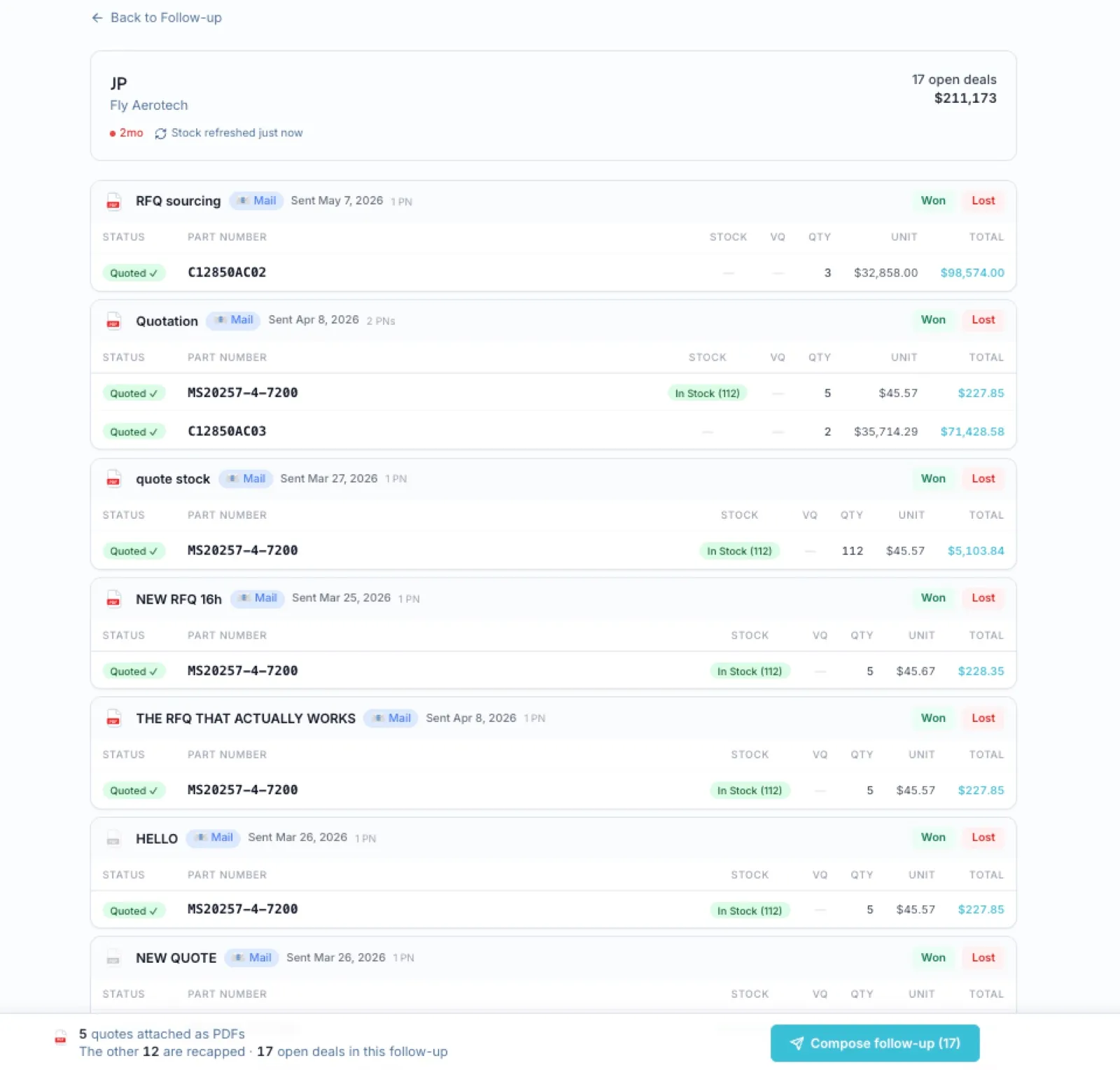
Trust that compounds. A desk that trusts its tooling uses it on every RFQ, not just the easy ones, and that is where the volume gain comes from. The teams that get burned by a self-acting agent once tend to switch the whole thing off. Less AI, placed exactly where it belongs, ends up delivering more automation than the maximalist version, because it is still running six months later.