
Insights
How do you judge an AI tool for aircraft parts quoting?
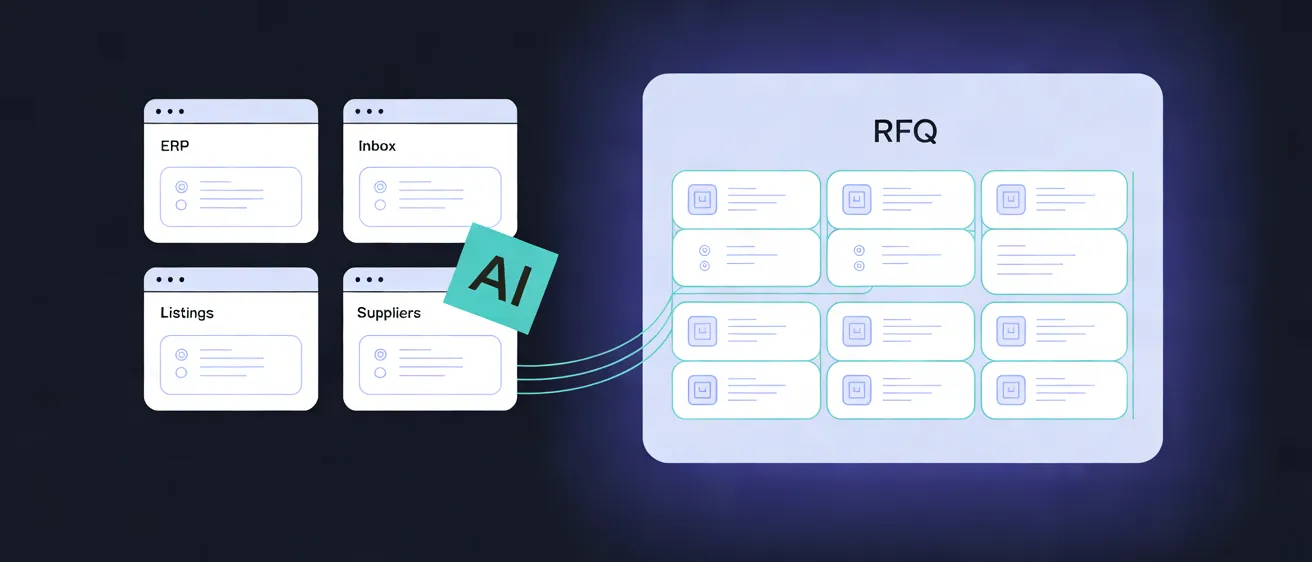
Ask the vendor one question: on your next RFQ, who goes and gets the price? An AI button added to one step, like pulling part numbers out of a PDF, helps on that step and then waits for your trader to find the price by hand. AI quoting software built around the RFQ reads the request and gathers what the trader needs before he opens it. The trader still decides and sends.
What does a trader need before he can quote a part?
Four pieces of information, in four different places. Your ERP holds the last time you sold this part number and its condition. What this customer wrote to you last month sits in the trader’s mailbox. Market listings sit on platforms like ILS and PartsBase, where sellers post the parts they have. Supplier availability and prices come back by email, one quote at a time.
When I was a trader, every request started with a tour of these windows. Most desks still work this way: the trader opens each window, copies what he finds and only then writes a price.
What does an AI button actually do?
It speeds up one step. A button that extracts the part numbers from a PDF RFQ saves real typing. A button that summarizes the customer’s email saves some reading.
But to quote, you need the price. The button does not go and get it. It waits for someone to bring it the information, so your trader still makes the tour of the windows, one by one.
I call this an AI wart: AI stuck onto one step of a cycle that is still done by hand. In my view, it does not change much in a trader’s day. The time goes into finding the right last sale, the right condition and a supplier price that is still valid.
What does AI built around the RFQ do differently?
It starts from the request and goes to get the sources itself. When an RFQ lands in Outlook, aersyn.ai reads it and normalizes the line items, whether it comes as an email thread, a scanned PDF or an Excel file. When your trader opens it, each line already shows whether it is ready to quote from stock or needs sourcing.
For a part in stock, the price comes from your own data: the stock file you keep and the price rule you set for that customer. Before it prices anything, the software still has to check the part number, the condition and your rule.
For a part you have to source, your trader searches live availability on ILS and PartsBase from the deal screen, picks his suppliers and the system prepares the supplier requests. The quotes that come back are matched to the deal and shown side by side, next to your own quote history for that customer.
When the customer’s PO arrives, aersyn.ai reconciles it against your quote and flags any price or quantity gap before the parts leave the shelf. The full check is described in how to reconcile a customer PO against your quote.
What stays with the trader?
Every decision that commits you to a customer. The AI can misread a line in a supplier PDF, so your trader checks what it read. He picks the supplier, sets his price and sends the quote himself.
The system does the tour of the windows, so your trader spends his time on the choices a customer pays him for.
Do you have to replace your ERP?
No. Your ERP keeps your purchases, your sales and your stock. aersyn.ai reads what you export from it and your stock files. An ERP the system has not met before gets connected during setup, case by case.
What should you ask in the next AI demo?
Four questions show whether you are looking at a wart or a system built around the RFQ:
- On a part in stock, who looks up the price?
- On a part you do not stock, who searches the market and where do the supplier quotes land?
- When the PO arrives, what checks it against the quote you sent?
- Which steps does your trader still do by hand, window by window?
If the honest answer to the first question is “your trader”, the AI has only made one window faster. You can follow each step on a real RFQ in the product tour.