
Insights
Can a small aircraft parts trading desk use AI without its own AI team?
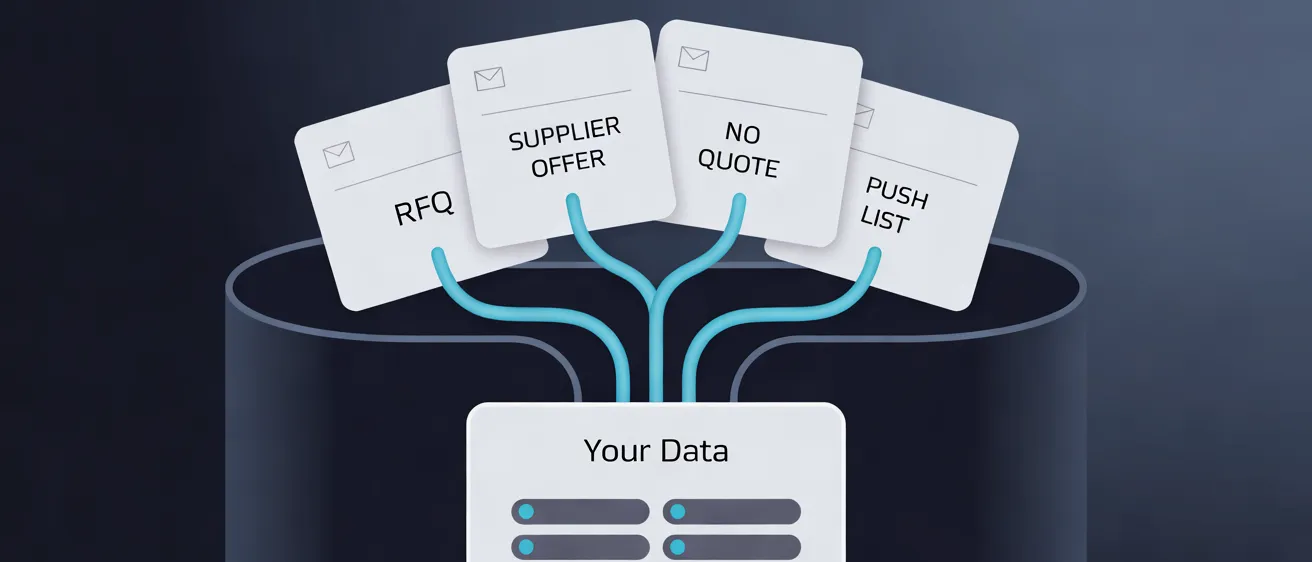
Yes. A desk of ten traders already owns the data an AI project needs. It sits in the mailbox: the requests, the supplier offers and the replies that say a part is not available. What the desk lacks is a team to put that data to work. Software built around the RFQ can do that work, with your rules and with your trader keeping the decision.
What do the largest parts traders say about AI?
In Aviation Week on November 6, 2026, Abdol Moabery, the CEO of GA Telesis, said: “A chatbot attached to an [enterprise resource planning] system is not an AI strategy.” I agree with him.
He also said where the advantage will go: “The competitive advantage will belong to companies that have proprietary data, understand that data, have the infrastructure and people to use it and can demonstrate that AI is actually changing decisions and financial outcomes.”
According to the same article, GA Telesis began investing seriously in AI in 2022 and now has a specialized arm that looks at how data and AI can improve the way it prices, buys, repairs and positions inventory. A group of that size can afford it.
What data does a ten-trader desk already own?
More than it thinks. Every day the mailbox receives customer requests, supplier offers, no-quotes, replies that say a part is out of stock and push lists, the stock lists suppliers send without being asked. Each one says something about the market: who is looking for what, who holds it, at what price and in what condition.
On most desks, part of this gets recorded and the rest is lost. Which supplier replies fast, at the right price, with the certificates? That is usually answered by gut feeling.
What is missing on a small desk?
The people and the tools to use that data. A desk of ten traders does not have a data team and its traders have no time to file every supplier reply by hand.
An AI button added to the ERP does not fill that gap. It helps on one step, then waits for someone to bring it the information. How do you judge an AI tool for aircraft parts quoting? goes through the difference.
What does that team’s work look like when software does it?
It starts in the mailbox. aersyn.ai works in Outlook, where your trader already works. Nothing goes through a chatbot. It reads each request, checks it against your stock and applies your pricing rules before a number reaches the trader. By default he reviews each prepared quote and sends it with one click. That is the human-in-the-loop principle.
On the buying side, each supplier reply is read and attached to the deal it answers, no-quotes included. Over time the desk sees which suppliers reply, how fast and with which certificates, on its own numbers. Choosing whom to contact stays a human decision: aersyn.ai never contacts a supplier behind your back. The product page shows the whole cycle.
I build aersyn.ai with the trading desks that use it. Each desk keeps its own data and its own view of the market.
Whose price is it?
Yours. The price comes from a rule built with you, on your commercial policy and the data you hold at that moment. You decide.
What can run without a trader?
Only what you switch on. Auto-quote answers platform requests, such as those from ILS and PartsBase, on the stock you give it. Reserved stock is not offered. A part you do not hold goes to a trader.
Platform requests convert little. Competition is heavy and many buyers only want a price check, so answering all of them by hand is not worth a trader’s morning. He picks his best customers and the rest stays unanswered. In October 2026, for my clients who turned auto-quote on, 6,429 platform requests received their quote this way, without a trader touching them.
Before you open a scope, measure it on real requests. How do you handle the RFQs that pile up in the ILS and PartsBase mailbox? explains how.
How do you know it changes decisions and results?
That is the last part of Moabery’s sentence and the hardest one. I do not have an exact before and after figure. What I have is the count above and what a broker I work with told me: he signed “orders we never imagined we would get.”
So start with a question you can answer today. Where are last month’s no-quotes now? If they sit in a mailbox folder, your desk owns the data and nothing uses it yet.